
{{selectedAlertBand.alertDescription}}
{{selectedAlertBand.incident.heading}}
Message last updated - Monday 09th March 2026
{{selectedAlertBand.incident.heading}}
Message last updated - Monday 09th March 2026
{{selectedAlertBand.alertLinkText}} {{selectedAlertBand.alertLinkText}}
For further updates subscribe
With soil health promoted as being key to future agricultural policy (plus new measures of success for agriculture being developed), we want to work with farmers. Getting ahead of the game identifying and supporting healthy soils.
Most farmers think of a healthy soil as one which allows earlier travel, easier cultivation and unrestricted root movement. Ultimately a soil which produces healthy crops.
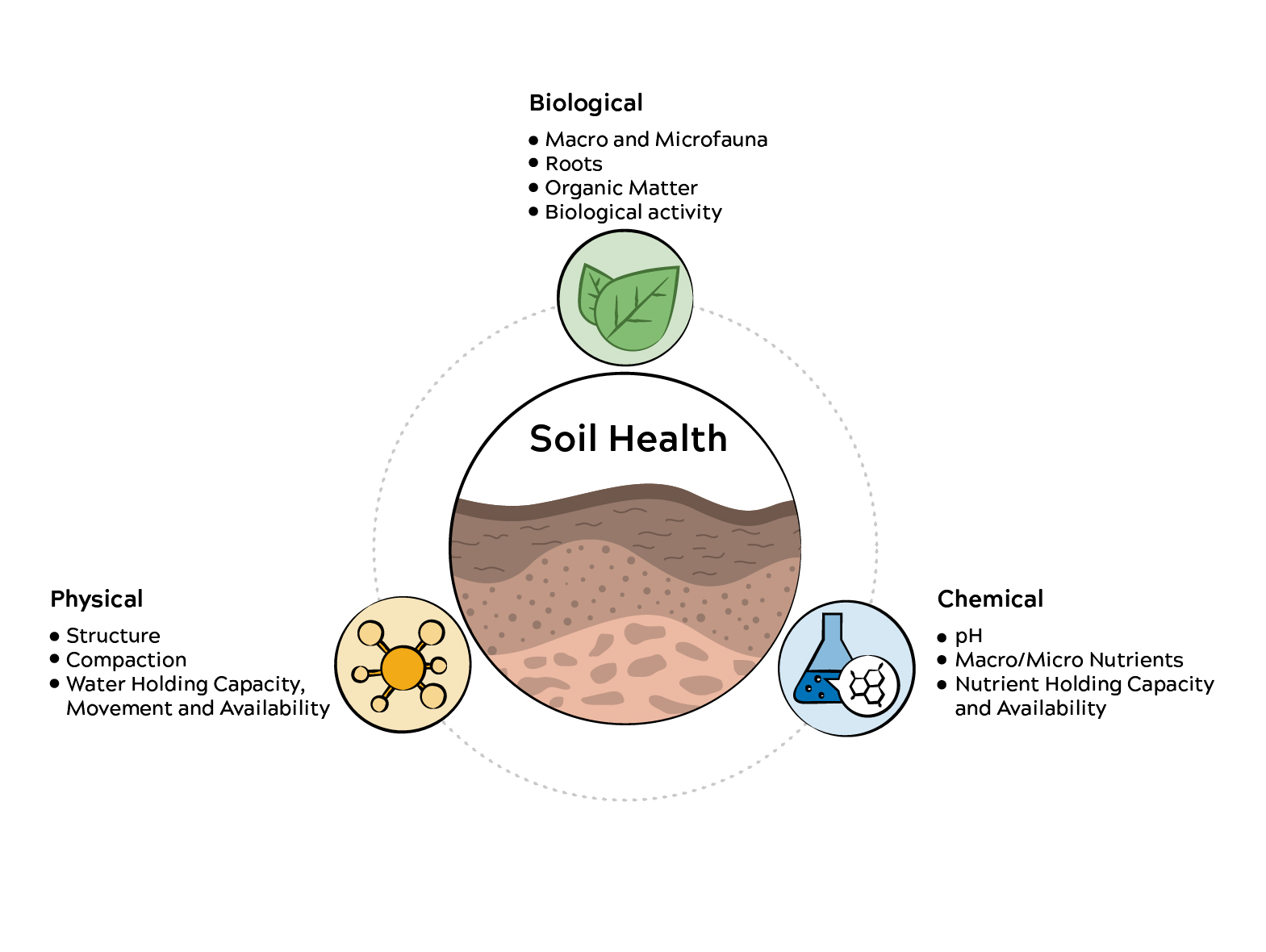
As a water company we think of healthy soil in relation to its ability to hold onto water (slow the flow). As well as an aerobic environment for bacteria to thrive in (releasing nutrients for crops to uptake and degrading pesticides). This reduces losses to watercourses - thus healthy water.
Soil Health Triangle
Early 2019 we took 324 soil samples, from 143 individual holdings across 10 drinking water protected areas around the region. The samples were analysed via Yara Analytical Services under their Broad Spectrum Soil Health test.
Covering a range of parameters including soil type, pH, macro/micro nutrients as well as soil respiration, carbon:nitrogen ratio and organic matter the labs gave each field a soil assessment score and recommendations.
Farmers were able to see how their soils were responding to current actions and if any new approaches were having an effect. One catchment farmer, who felt his management was helping improve soil structure and benefited water holding capacity plus crop establishment.
Catchment farmer
We used anonymised results to look for trends across the region. Helping formulate catchment specific base lines to support our long term soil health strategy. With this strategy we can focus on supporting farmers in our drinking water catchments with local initiatives to aid both food production and water resource protection. Ultimately a positive for our customers and the environment.
Jonathan Telfer and Caroline Hobson are business developers for Yara Analytical Services and gave their support to the sampling project.
Jonathan Telfer, Business Developer, Yara Analytical Services
Caroline analysed the data which presented some very clear differences between the catchments. Understanding what is achievable at a local level provides those catchment farmers with more locally achievable targets.
Caroline Hobson, Business Developer, Yara Analytical Services
This highlights our strategy for local solutions to local problems, as being a positive approach providing more relevant advice and support.
Comparing catchment data sets uncovers trends which could be addressed. Providing benefits to future crops and the environment. For instance, soil deficiencies in potassium and magnesium may make the crop more susceptible to drought stress. Potassium aids water regulation and cell strength while magnesium is required for chlorophyll, only naturally entering the crop via soil water transfer.
Carbon to nitrogen ratios (C:N) were another interesting and variable set of data across catchments. Organic carbon energises bacteria (helping breakdown nutrients and make them available to the crop) however, they also require nitrogen to make use of this energy and reproduce. An imbalance may result in nutrients being locked up.
Phosphate ranged from being high in some catchments to severely deficient in others. Identifying which nutrient(s) you need to address and at which time (maximising crop uptake) helps choose appropriate management and subsequently build healthy robust soils.
In conclusion, the measured resources held within the soil only represent a portion of the potential you have. Unlocking this potential is key. Thus if we consider soil respiration as one measure of health then the other should be achieving and maintaining good soil structure - so those resources can be accessed by the growing crop.