{{selectedAlertBand.alertDescription}}
{{selectedAlertBand.incident.heading}}
Message last updated - Saturday 28th March 2026
{{selectedAlertBand.incident.heading}}
Message last updated - Saturday 28th March 2026
Message last updated - Saturday 28th March 2026
{{selectedAlertBand.alertLinkText}} {{selectedAlertBand.alertLinkText}}
For further updates subscribe
Focussing on addressing water quality and water resource challenges across our 11 A-WINEP target catchments. Specifically, in reducing the nutrient input to our environment and exploring opportunities to address low flows.
We'll be adopting 2 approaches:
The 11 A-WINEP rural target catchments are:
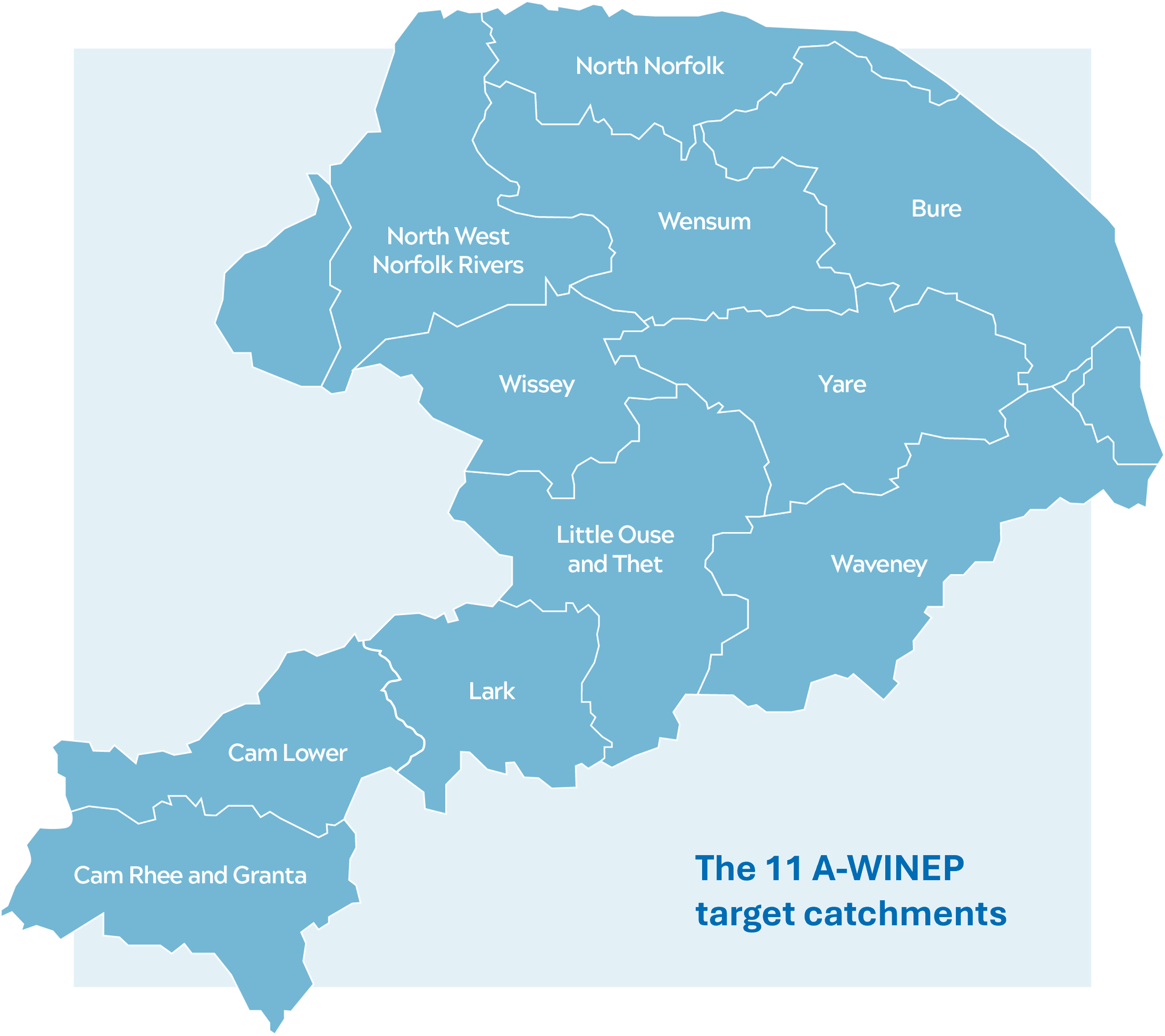
NbS (Nature based Solutions) Modelling
In preparation for A-WINEP, a specialist external consultant was employed to conduct extensive modelling across the 11 rural and two urban A-WINEP catchments. This modelling looked at both water quality and flow.
The results of this modelling enables the prioritisation of A-WINEP investment based on the extent of the impact on the ecological health of the catchment achievable through the implementation of specific nature-based solutions. In other words, the modelling has identified ‘target hotspots’ – areas where we know investing in specific NbS will deliver the greatest impact.