{{selectedAlertBand.alertDescription}}
{{selectedAlertBand.incident.heading}}
Message last updated - Wednesday 27th May 2026
{{selectedAlertBand.incident.heading}}
Message last updated - Wednesday 27th May 2026
Message last updated - Wednesday 27th May 2026
{{selectedAlertBand.alertLinkText}} {{selectedAlertBand.alertLinkText}}
For further updates subscribe

The East of England faces significant water supply challenges due to a changing climate, population growth, and the need to protect the environment.
Our region is one of the fastest growing in the country, with many new homes planned over the next few years. What’s more, a changing climate means drought and hotter summers, as well as intense rainfall events are predicted to become more frequent.
Our latest Water Resources Management Plan shows that, without intervention, by 2050 we'll be facing a shortfall of 593 megalitres every day. That’s around half the amount of water we put into our network currently.
That's why we're investing heavily now to help keep taps running long into the future, while also exploring how we can use water more efficiently, make better use of existing water supplies, and access new sources of water where needed. We’re also committed to reducing the amount of water we take from sensitive sources such as chalk streams and wetlands. Seawater desalination helps us achieve this, as it takes water from the sea instead.
New water sources
We’re progressing plans for two new reservoirs. One in Lincolnshire, and another in the Cambridgeshire Fens, in partnership with Cambridge Water.
What we're proposing
Even with all these great projects, we’re still predicting a shortfall in supply. That’s why we’re exploring innovative new ways to secure more water for the future – and our desalination plants are a key part of this. We’re proposing two new seawater desalination plants for our region – one in Norfolk and one in Lincolnshire.
The projects are in the very early stages. We're currently undertaking a detailed site selection process, which will help us identify a preferred location for each plant. Once potential sites have been identified, we would look to seek your feedback on them and will continue to do so as we develop the project’s further.
Subject to successful planning and approval of the projects we are aiming to construct the plants and bring the water into supply by 2040.
What is desalination?
Seawater desalination plants turn sea water into clean, drinkable water for homes and businesses. Because the water comes from the sea, it's available all year round. With hotter, drier summers expected, desalination would provide a reliable supply option.
Although we're among the first in the UK to develop seawater desalination, it is used widely across the world with over 16,000 desalination plants providing clean water in over 170 countries.
How desalination works.
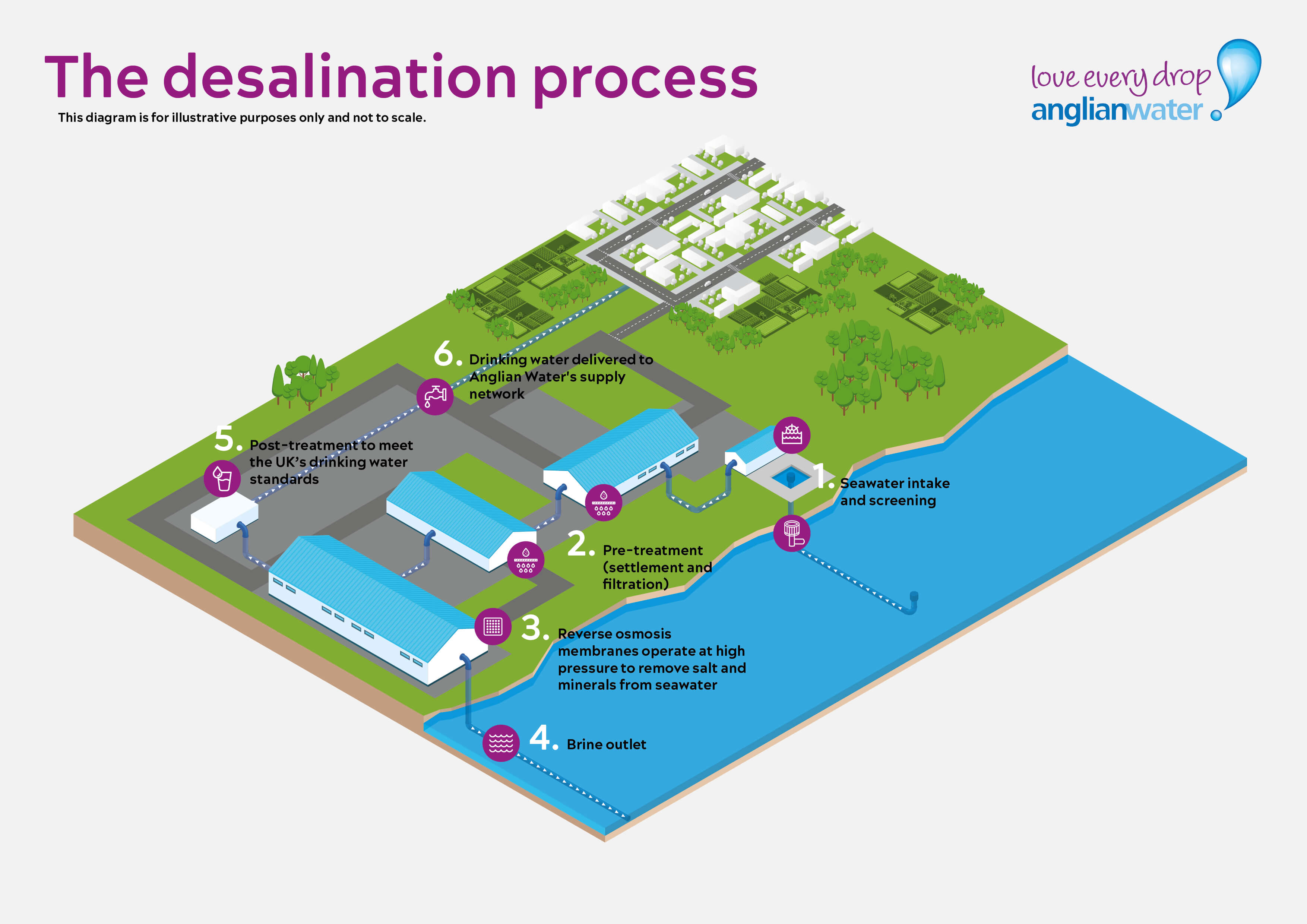
Seawater desalination describes a process whereby salt and other impurities are removed from seawater so it can be further processed to create water suitable for drinking.
For both projects, an intake pipe would gently draw water from the North Sea in to the desalination plant - a process known as abstraction. To safeguard wildlife and prevent large debris from entering the system, the intake will be fitted with protective filters.
Any larger materials and particles would be removed from the water first through screening and pre‑treatment before the water enters the reverse osmosis process.
Reverse osmosis works by forcing water through a membrane - similar to a very fine mesh - which removes salt and other impurities. The water is then conditioned by adding essential minerals, making it safe and suitable for drinking.
Benefits of seawater desalination
Our desalination plants are one of the ways we're building for better. Proudly developing innovative ways to secure more water for the future. Seawater desalination could help to:
Our work to date